Ceetrix and Claude Code helped us move quickly. The real achievement was making that speed trustworthy.
Disclosure: Ceetrix is a platform built by a close friend of mine, a former Googler, seasoned Chief Product Officer, and agentic AI expert.
AI coding stories often celebrate speed while ignoring discipline.
That works right up until the software starts touching workflows that matter.
In our case, we used Claude Code and Ceetrix to move a serious B2B product forward in a single evening. But the important result was not simply that code was generated quickly. It was that the work remained governed from requirements through to production validation.
That difference is what made the outcome useful.
Start with evidence, not enthusiasm
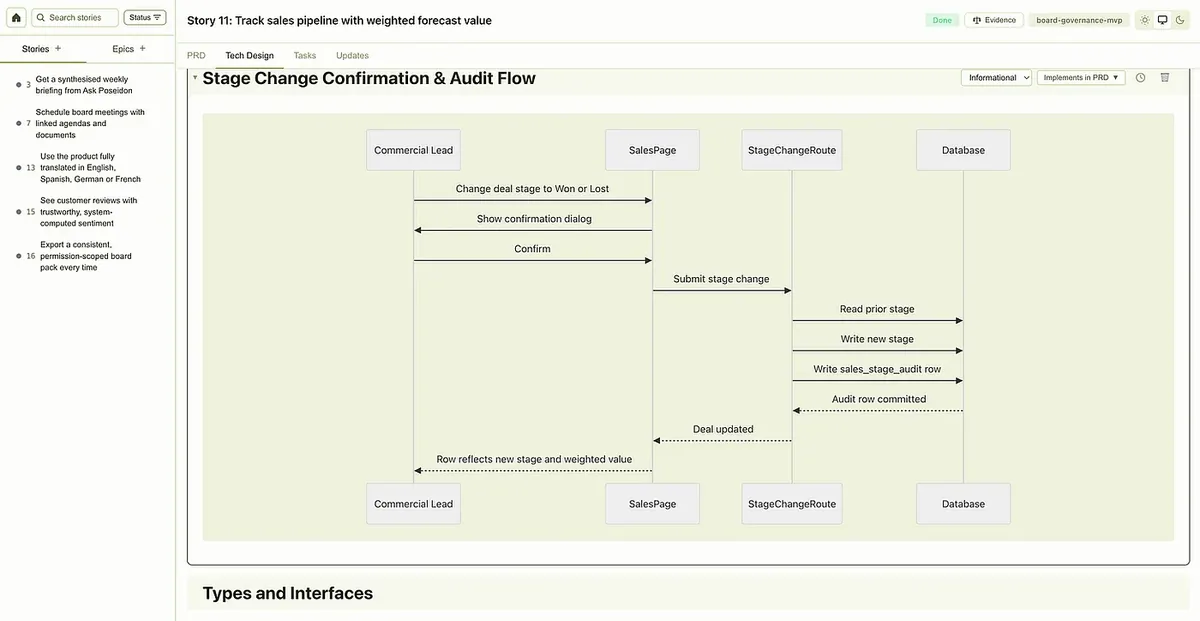
We did not begin with an open-ended build prompt. We began with a structured Product Requirements Document and a separate gap analysis based on an existing application.
The Product Requirements stage was also preceded by building the Design System and locking it down with Guardrails in Claude Design before pushing the initial prototype into Claude Code. We'll cover that in another post.
That created three competing versions of truth.
The PRD described intended behaviour. The prototype suggested current behaviour. The repository revealed actual behaviour.
Only one of those could be treated as authoritative.
So the first step was not implementation. It was reconciliation.
Several areas of the product were stronger than expected. Others appeared more complete in the interface than they were in underlying logic. That is a common state in growing software, and it is precisely why governance matters. If you build on untested assumptions, AI only accelerates the risk.
Ceetrix imposed a delivery chain

Ceetrix enforced a structured path:
PRD → Design → Tasks → Tests
This prevented the team from jumping directly from idea to code. Every requirement had to become an explicit design. Every design had to generate concrete tasks. Every task had to be backed by tests and validation.
That changed the role of the AI agent.
Instead of acting as a fast improviser, it became a contributor operating inside a traceable system. That matters because large language models are excellent at producing plausible answers. Plausibility is useful, but it is not evidence. This is on top of the guardrails in our CLAUDE.md and hooks.
A governed workflow narrows the gap between the two.
The first release focused on operational integrity
The first production story chosen was currency handling. We focused on the way the application handled currency logic first and chose an API integration to validate currency changes against 30 currencies.
The existing application relied on hardcoded values, which is acceptable in a prototype but not in software expected to support serious operating decisions. The work therefore involved replacing static assumptions with live reference data, visible annotations, and safer fallback logic.
This was about more than technical correctness.
If a system converts a number, it should make that visible. If it uses a reference rate, it should say so. If it falls back, that behaviour should be explicit. Good governance means the system is honest about its own logic.
The story was implemented, tested, and validated in a real environment rather than treated as complete on the strength of code generation alone.
Validation exposed a live security issue
During release validation, we discovered that a public-facing settings path exposed more information than intended. On closer review, the issue appeared to involve a sensitive value pattern and therefore required immediate containment.
The relevant data was corrected, the exposed path was narrowed, and the surrounding guardrails were improved so the same class of issue would be less likely to recur. The episode demonstrated something important about governed delivery. When teams validate carefully against real behaviour, problems surface that faster but looser workflows might miss entirely.
The lesson was not that AI independently "did security".
The lesson was that a traceable, evidence-based workflow made it difficult for the problem to remain hidden.
The second story strengthened settings behaviour
A second production story focused on settings and preference handling. Curated choices were properly enforced, preferences were persisted more reliably, and important changes became auditable. Smaller behavioural issues were also corrected as part of end-to-end validation.
This type of work rarely produces dramatic headlines, but it materially improves trustworthiness.
That is the broader point. Serious software quality often improves through cumulative integrity gains rather than spectacular features.
The control boundary mattered as much as the code

Throughout the session, the AI agent could analyse, design, implement, test, and explain. But it did not cross irreversible boundaries without approval.
- Before committing, it paused
- Before deploying, it paused
- Before touching production-shaped data, it paused
That is not inefficiency. It is a functional control model.
In any serious operating environment, capability and authority must remain distinct. AI-assisted product development should follow the same rule.
Conclusion
By the end of the session, we had shipped meaningful improvements, tightened operational behaviour, uncovered and resolved a live issue, and advanced the wider MVP through a clearer structured path.
But the more important outcome was conceptual.
AI did not replace product governance.
It made disciplined product governance possible at much higher speed.
That is a far more durable story than another example of code being generated quickly.
The question for AI-assisted delivery is no longer whether a model can build. It is whether your process creates enough evidence to trust what gets built. It is where you require evidence before you trust what they have done. Are you governing your product delivery today? Check out Ceetrix.
I'll update you as we go along.