Insight
Operator-led thinking on governed AI.
The Insights page is not a general commentary feed. It publishes focused, useful pieces that speak directly to the concerns of founders, operators, leadership teams and boards considering a governed AI decisioning layer.
Written by Michael Fasosin, a technology entrepreneur, founder and adviser with more than thirty-five years across software, consulting and venture-building, with multiple exits.
AI has moved into the boardroom faster than governance has moved into AI.
Your leadership team has already adopted more AI than it has governed. That gap shows up the first time a board, a regulator or a counterparty asks how a decision was made.
The three figures come from different sources and describe different groups: board members and executives, investment professionals, and the law itself. They are not one sample.
Using AI a lot does not mean you use it well. We resell no one's software, so we can tell you what you do not need.
All pieces
-

The number, checked before your AI answers.
The three warehouse skills are available on request: what they check before your AI answers, and where the number goes after.
Read the article → -

The board sets the line. The agents work inside it.
Cash flow thirteen weeks ahead, tripwires that raise a decision, and rules your AI agents work within.
Read the article → -

Who signs for the $15-an-hour expert?
A credential tells you who is allowed to sign. It does nothing to the draft. Drafts multiply and the number of people who can sign does not.
Read the article → -

The record a new owner inherits.
After a sale the contracts transfer and the reasons stay behind. What a team that buys the business needs from the board record, and how to start keeping it.
Read the article → -

Start your AI operating system at the board.
Where would an AI operating system land first in a founder-led company? Our answer is the board.
Read the article → -

How to ask your own AI for a number you can trace.
A plain guide for a CFO, a CEO and a board observer: five habits that make an AI's number checkable, which skill answers which question, and how it reaches the board's record.
Read the article → -

When the model moves in-house, the memory has to be yours.
AI tokens keep getting cheaper, and AI bills keep rising. As companies spread their work across several models, the one thing that has to stay put is the organisation's memory.
Read the article → -

Why the record matters more than the model.
Ask an AI who approved a board decision and it answers fluently, confidently and differently each time. The fault is in what it stands on.
Read the article → -

When the quality gate caught the AI cutting a corner, twice in one afternoon.
A build log from Boardverse: two features shipped, and two separate times the same afternoon a review system caught Claude Code shipping less than what was promised, and sent it back to do the work properly.
Read the article → -

Teaching an AI to govern itself, so it could build software that governs boards.
Two days building board-resolution software with Claude Code and Ceetrix, under the same discipline the product itself demands of a board: every requirement traced, every step tested, every irreversible action stopped for a human sign-off.
Read the article → -
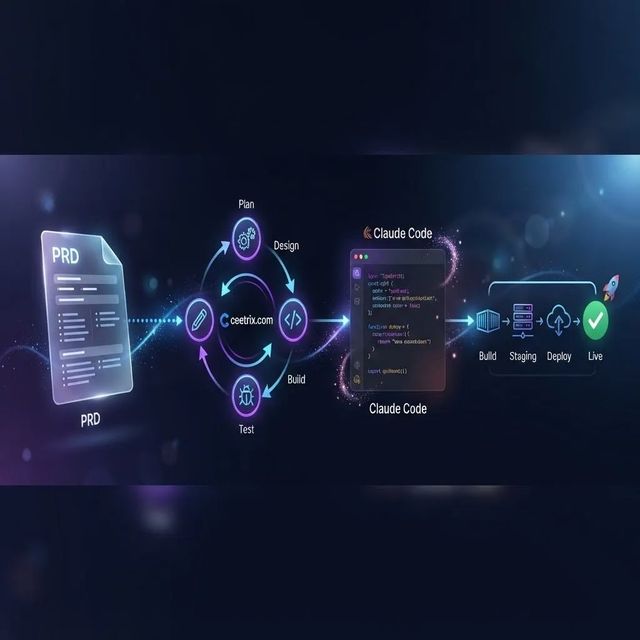
From PRD to production in one night, without sacrificing governance.
Claude Code and Ceetrix moved a serious B2B product forward in a single evening. The result that mattered was that the work stayed governed from requirements through to production validation.
Read the article → -

The new CEO's first blind spot is not strategy. It is visibility.
New leadership teams rarely fail because they read the numbers wrong. They fail because it takes weeks to assemble the numbers at all. Why visibility, not strategy, is the first-90-days blind spot.
Read the article → -

Where AI creates value in compliance-heavy and specialist advisory workflows.
Research and drafting are where AI does the heavy lifting in compliance-heavy and specialist advisory work. Judgement stays with the specialist. Where the line sits.
Read the article → -

What good governance looks like for an owner-managed service firm using AI.
Governance at this scale is not a policy document. It is four decisions and one named owner. What good AI governance looks like for an owner-managed service firm.
Read the article → -

Why process redesign matters more than prompt experimentation.
A clever prompt bolted onto a broken workflow is still a broken workflow. Why the return on AI sits in redesigning the process, not finding better prompts.
Read the article → -

How to reduce shadow AI without slowing the business down.
Staff are already using AI informally. The fix is not a ban. It is turning scattered usage into a governed, supported capability without slowing the business down.
Read the article → -

How founder-led service firms should assess AI readiness before buying tools.
Readiness is a leadership, workflow and governance question first, not a technology one. How to assess AI readiness properly before spending on tools.
Read the article →
















Insight questions
Who writes the insight pieces?
Michael Fasosin, founder and operator of Boardverse, with more than thirty-five years across software, consulting and venture-building, with multiple exits.
Does using AI a lot mean a company is good at it?
No. A few people saving time with a tool can look like a company that is ready. Leaders need to see what the whole company is relying on AI for.
Why does it matter that you do not resell software?
Because we can tell you plainly what you do not need. We earn nothing from selling you someone else's tool.
What is the confirmation gate, in one sentence?
Nothing a connected tool submits to a governance record becomes official until a person who did not submit it says so.